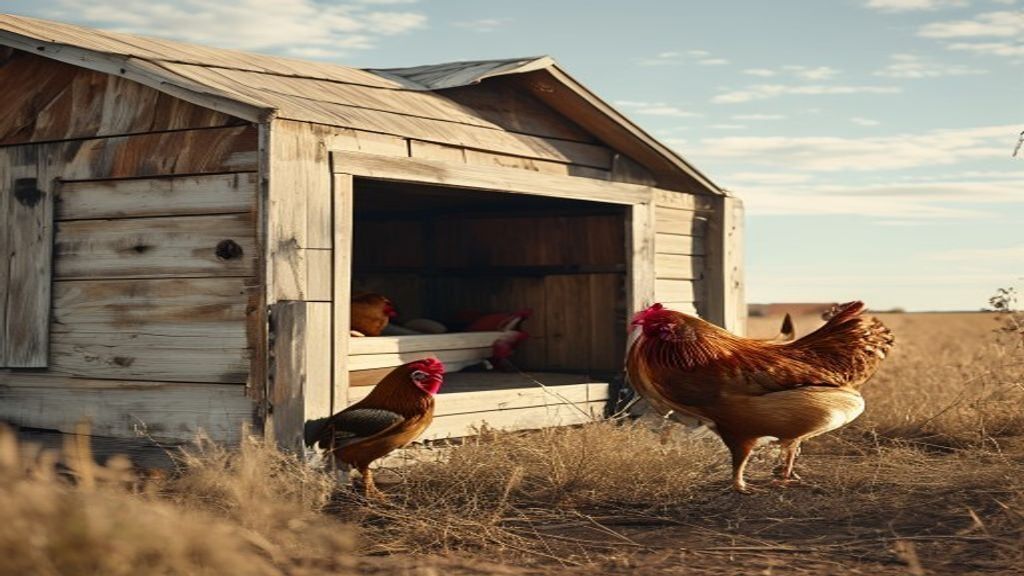
How to Winter-Proof a Chicken Coop on the Canadian Prairies
It’s late October in central Alberta. The forecast says -16 °C overnight and -28 °C by Tuesday. Your chickens still don’t have a heat source, the coop door is plywood with a gap underneath, and you read three contradictory blog posts about ventilation last spring.
Here is what actually keeps a small backyard flock comfortable through a Prairie winter, in the order it needs to happen. Nothing fancy, nothing performative — the goal is birds that lay through January, not a coop that wins a homesteading magazine spread.
When to start
Mid-September is the right call for the Prairies. By the first hard frost (usually first week of October on the Saskatchewan-Alberta line) the major work should already be done. If it’s late October and you haven’t started — that’s the situation most people are actually in, and it’s still fixable, just compress the schedule.
If you’re reading this in November and the wind is already howling: skip to the Common mistakes section. There’s a triage list there.
What you need
- One thermostatic coop heater (radiant panel, not space heater)
- A waterer that won’t freeze, or a backup plan for the one you have
- Roof and wall insulation rated for at least R-12 if your coop is uninsulated framing
- A latching coop door that closes flush — gappy doors lose heat fast
- Pine shavings (deep-litter method, more on this below)
- A thermometer with a remote outdoor sensor, ideally min/max recording
A lot of these are catalogue items we carry. Where we have a specific recommendation, it’s noted in the steps below.
Step 1 — Audit the air leaks
Walk into the coop on a windy afternoon. If you can feel air moving anywhere except the dedicated upper vents, that’s a leak. Caulk gaps around windows. Replace failing weather stripping on the people-door. Stuff steel wool into any rodent-sized hole — caulk alone won’t stop a determined mouse.
Do not seal the upper vents. A tightly closed coop builds humidity, and humidity in a -25 °C coop is what gives chickens frostbite — not the cold itself. Birds handle dry cold remarkably well; wet cold is what kills.
Step 2 — Insulate the right surfaces
Most home-built coops lose heat through the roof and the wall opposite the prevailing wind. Insulate those first. Foam board (R-7.5 per inch) glued and screwed against the inner wall, then sheathed with thin plywood so birds don’t peck and eat the foam. R-12 minimum is the working target; R-20 if you’re rebuilding anyway.
Skip the floor unless your coop is on bare ground. Deep litter (Step 4) does the floor’s heat retention.
Step 3 — Pick a heat strategy
The cheapest workable heat for a backyard coop on the Prairies is a thermostatic radiant panel — typically 160 W to 200 W, mounted on the wall, set to come on around -10 °C. They’re safer than heat lamps (heat lamps cause coop fires; this is not a hypothetical), and they only run when the temperature actually drops.
If you’re shopping for one, the thermostatic coop heating panels we carry are the model we’d buy ourselves — adjustable thermostat, low draw, mountable to a stud.
How much heat? Aim for the coop interior to stay above -5 °C even when it’s -28 °C outside. You’re not heating to T-shirt temperature. You’re nudging the floor of the temperature curve up to where birds can manage it.
Step 4 — Set up deep-litter bedding
Lay 4–6 inches of pine shavings on the floor. Each week, fork the soiled top layer into the rest and add another inch on top. Through the winter the litter composts in place, generating heat from the bottom up. By March it’s a foot deep and 5–10 °C warmer at floor level than the air.
Don’t use straw — it’s hollow and doesn’t compost the same way. Don’t use cedar — the oils irritate respiratory tracts.
Step 5 — Solve the water problem
This is the single thing that breaks down most often in Prairie winter coop care. Solid ice in a waterer at 7 a.m. means birds aren’t drinking, which means they aren’t laying.
Three workable approaches:
- Heated base under a metal galvanised waterer — works to about -25 °C, fails below that.
- Submersible aquarium-style heater in a deep poultry waterer — works to -35 °C, requires the waterer to be deep enough to submerge the element.
- Replace twice a day with warm water — works at any temperature, but only if you’re home twice a day. The math on a -32 °C morning: water freezes inside 30 minutes regardless of waterer.
For a small flock (under 12 birds) the swap-twice-a-day method is what actually works on the Prairies. Buy a second waterer, keep one in the house thawing while the other is in the coop. We carry the smaller automatic chicken drinker cups for flocks where individual cups make daily swap-out faster than a single big fountain.
Step 6 — Manage the door
The coop door takes more abuse than anything else: opens and closes daily, gaps fill with snow, hinges seize. Two options:
- Manual — you open at sunrise, close at sundown. Works if you’re consistent. The day you forget, the predator that’s been watching wins.
- Automatic — a timer-controlled or light-sensor door means the birds get out at first light and locked in at dusk regardless of your schedule. The solar-powered automatic coop doors are the better Prairie option — no extension cord to your coop, no battery dying at -30 °C inside a non-insulated unit.
Step 7 — Daily winter walk-through
Two minutes, every morning. Check the heater is on, the water isn’t frozen, no birds are hunched in a corner with frostbitten combs, the door latched cleanly behind you yesterday. That’s it. The reason coops fail in January is usually a small problem that started in November and got bigger because nobody walked through.
Common mistakes
- Sealing every vent — drives humidity up, causes frostbite. Keep upper vents open year-round.
- Heat lamps — cause coop fires. Use radiant panels. This is not a preference, this is fire safety.
- Vaseline on combs — old wisdom, doesn’t actually help, sometimes makes it worse by trapping moisture against skin. Better fix: humidity control + adequate roost space so birds can warm their faces against their bodies.
- One enormous water fountain that freezes by 9 a.m. — small swappable waterers move ice off the bird-access path faster.
- Adding insulation but not sealing leaks first — heat just escapes around the insulation. Air-seal is step 1, insulation is step 2.
Quick recap
If you only do four things:
- Insulate roof and windward wall to R-12 minimum
- Mount a thermostatic radiant heating panel set to switch on at -10 °C
- Deep-litter the floor with pine shavings, top-up weekly
- Solve the water problem before December — pick the swap method that fits your schedule and stick to it
A small backyard flock kept dry, draft-free, and watered will lay through a Prairie winter. The birds are tougher than the internet thinks. The coop is the limiting factor.
— The Vastura crew
Social caption (for Instagram / Facebook on publish):
If your chickens stop laying in January, it’s almost never the breed. It’s the coop. Walk-through and full how-to on prepping a small backyard coop for -30°C Prairie winters — link in bio.
